

On JPMorgan Chase’s October 13 earnings call, CEO Jamie Dimon said the bank won’t let just any outside AI agent inside the company, because it is too risky for clients and for the bank, and he warned that rogue agents could number in the thousands. Two days later, Schwab’s CEO said Schwab is blocking unauthorized agents that log in on clients’ behalf, while letting clients’ AI models connect through channels Schwab controls.
Source: JPMorgan Chase, third-quarter 2026 earnings call, Oct. 13, 2026; Charles Schwab, third-quarter 2026 earnings call, Oct. 15, 2026.
Neither bank is saying no to AI. JPMorgan says it uses agents internally. Both are deciding where the control sits, and that is the tension behind every AI and analytics plan: someone has to be able to use the data.
Part 1: Finding it a day later isn’t protecting it
Part 2: Most agents reach sensitive data with no verified DLP
The pitch is speed
The vendor claims in Part 3 carry a second theme. Governance is sold as the thing that lets agents move fast. Immuta (March 2026) pitches access granted as agents need it, and Informatica (May 2026) pitches a trusted data foundation for them. The promise is that control and speed are not opposites.
We agree with that goal. The question is where the control sits. If it sits on the agent, every new agent needs its own setup before it can move. If it sits on the data, the data can keep moving.
Protection that doesn’t break the work
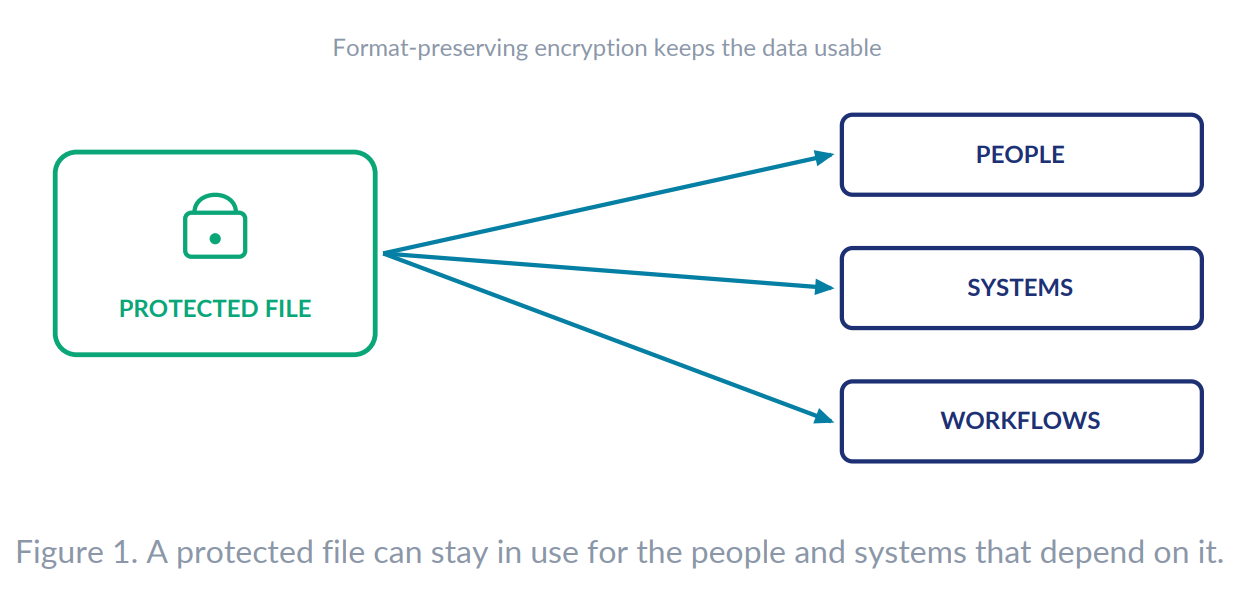
Format-preserving encryption keeps protected data in the format applications expect. An encrypted card number still looks like a card number to the system that stores it, so the work built on that data keeps running. For more, see Part 2 of “The Data, Not the Agent.”
On supported databases and cloud storage, masking replaces sensitive values with realistic ones of the same type and length, and consistent masking keeps records matching across systems.
This keeps applications, test environments, and reporting running. Analytics and machine learning that train on the real values are a different conversation.
What the series adds up to
- Finding data a day late isn’t protecting it. When PK Protect encrypts a file, the protection stays on it, and an agent without the key can’t read it.
- Most agents reach sensitive data with no verified DLP on the connection, and DLP and DSPM still work at the exit or on the map.
- Agents you didn’t deploy can still read your data. Most of the field is fencing the agent. We fence the data.
- Protection that keeps data usable lets applications, test environments, and reporting keep running.
If you want to know what sensitive data is sitting in your environment today, and whether it would still be protected if an agent reached it, we’re happy to talk it through.